
How Memory Takes Shape
Minyu Chang
A faculty spotlight on memory and how we learn.
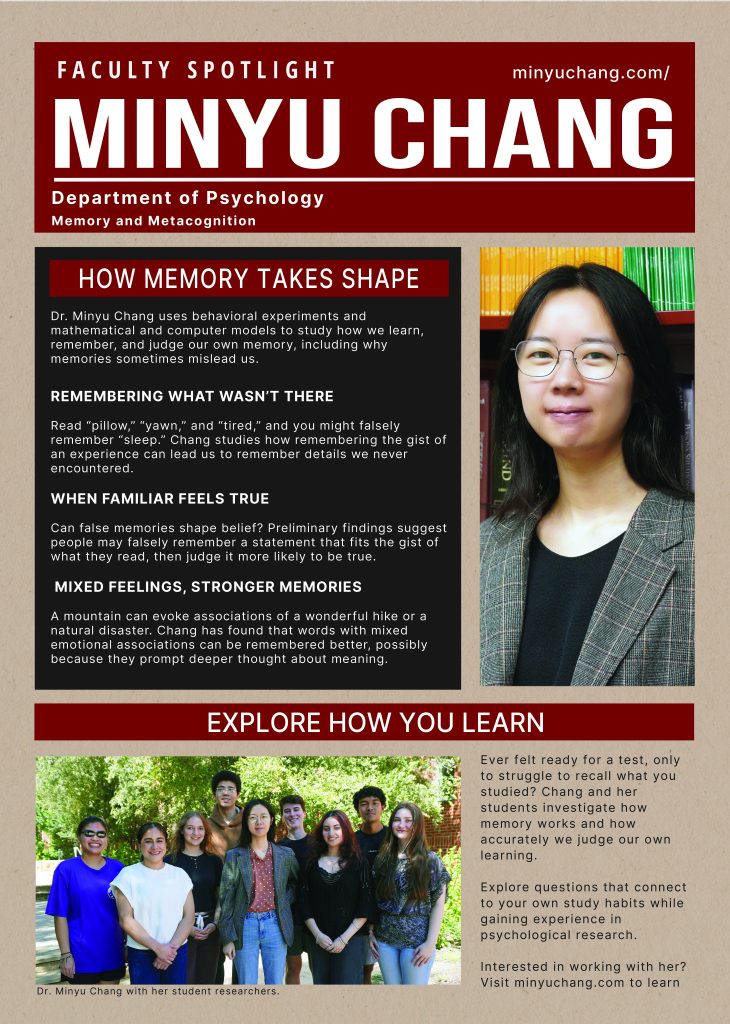
POSTER TEXT
How memory takes shape
Dr. Minyu Chang uses behavioral experiments and mathematical and computer models to study how we learn, remember, and judge our own memory, including why memories sometimes mislead us.
Remembering what wasn't there
Read “pillow,” “yawn,” and “tired,” and you might falsely remember “sleep.” Chang studies how remembering the gist of an experience can lead us to remember details we never encountered.
Explore how you learn
Ever felt ready for a test, only to struggle to recall what you studied? Chang and her students investigate how memory works and how accurately we judge our own learning. Explore questions that connect to your own study habits while gaining experience in psychological research. Interested in working with her? Visit minyuchang.com to learn about joining her lab.
When familiar feels true
Can false memories shape belief? Preliminary findings suggest people may falsely remember a statement that fits the gist of what they read, then judge it more likely to be true.
Mixed feelings, stronger memories
A mountain can evoke associations of a wonderful hike or a natural disaster. Chang has found that words with mixed emotional associations can be remembered better, possibly because they prompt deeper thought about meaning.