
Life Inside the Walls
Melanie Godsey
A faculty spotlight on everyday life in the ancient Mediterranean.
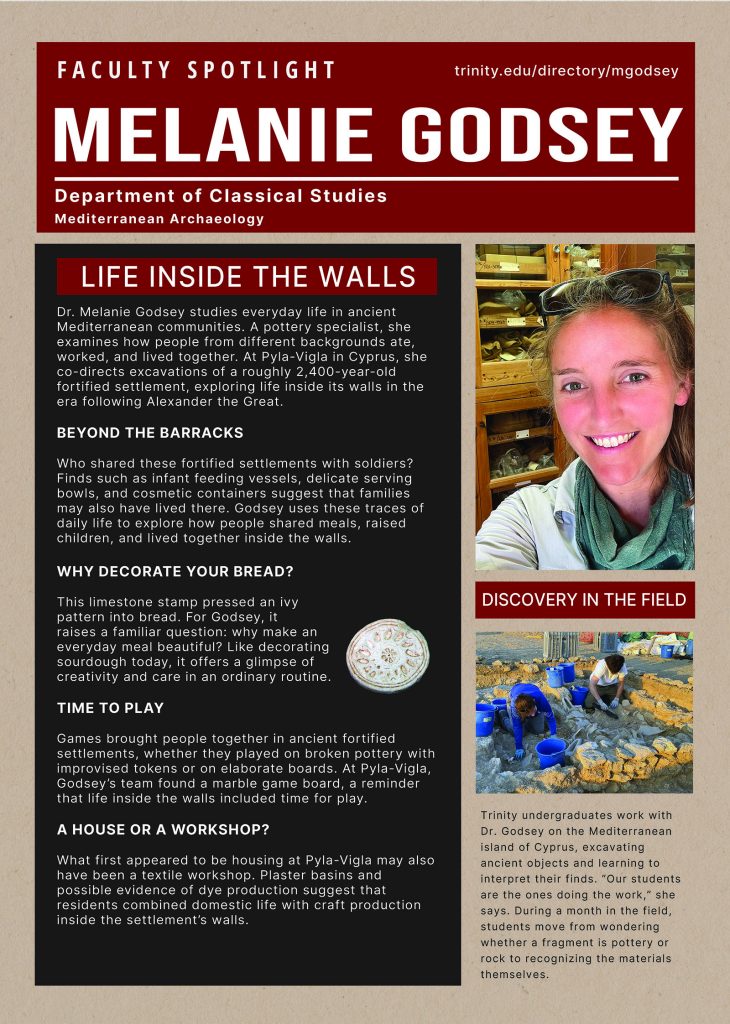
POSTER TEXT
Life inside the walls
Dr. Melanie Godsey studies everyday life in ancient Mediterranean communities. A pottery specialist, she examines how people from different backgrounds ate, worked, and lived together. At Pyla-Vigla in Cyprus, she co-directs excavations at a roughly 2,400-year-old fortified settlement, exploring life inside its walls in the era following Alexander the Great.
Beyond the barracks
Who shared these fortified settlements with soldiers? Finds such as infant feeding vessels, delicate serving bowls, and cosmetic containers suggest that families may also have lived there. Godsey uses these traces of daily life to explore how people shared meals, raised children, and lived together inside the walls.
Why decorate your bread?
This limestone stamp pressed an ivy pattern into bread. For Godsey, it raises a familiar question: why make an everyday meal beautiful? Like decorating sourdough today, it offers a glimpse of creativity and care in an ordinary routine.
Time to play
Games brought people together in ancient fortified settlements, whether they played on broken pottery with improvised tokens or on elaborate boards. At Pyla-Vigla, Godsey’s team found a marble game board, a reminder that life inside the walls included time for play.
A house or a workshop?
What first appeared to be housing at Pyla-Vigla may also have been a textile workshop. Plaster basins and possible evidence of dye production suggest that residents combined domestic life with craft production inside the settlement’s walls.
Discovery in the field
Trinity undergraduates work with Dr. Godsey on the Mediterranean island of Cyprus, excavating ancient objects and learning to interpret their finds. “Our students are the ones doing the work,” she says. During a month in the field, students move from wondering whether a fragment is pottery or rock to recognizing the materials themselves.